Ever found yourself staring at an empty five-gallon jug, wrestling a new one onto the cooler, and wondering if there’s a better way to get clean, refreshing water? You’re not alone. In homes and offices worldwide, the choice between traditional bottled water coolers and modern bottleless systems often comes down to more than just convenience—it’s about understanding the true cost, long-term savings, and environmental impact. This guide will dive deep into the financial realities of both options, helping you make an informed decision for your hydration needs and your budget.
Understanding Water Cooler Types
Before we break down the costs, let’s clarify what each system entails.
Bottled Water Coolers are the most recognizable type, featuring a large, inverted plastic bottle (typically 3- or 5-gallon) perched atop a dispenser. These units draw water directly from the pre-filled bottle, often providing chilled or hot water. While seemingly straightforward, their operation relies on a continuous supply of delivered or purchased bottles.
Bottleless Water Coolers, also known as point-of-use (POU) or mains-fed coolers, connect directly to your existing cold water line. Instead of external bottles, these systems incorporate advanced filtration technology to purify tap water on demand. They offer a continuous, unlimited supply of filtered water, often with hot, cold, and sometimes even sparkling options, without the need for manual refills.
The Upfront Investment: Initial Costs Compared
When considering a new water cooler, the initial purchase price and installation fees are often the first financial hurdles. However, these figures paint only a partial picture of the total investment.
For bottled water coolers, the upfront cost is generally lower. You might purchase a basic model for a modest sum, or you could opt for a rental plan where the dispenser itself is provided at little to no initial cost. However, it’s crucial to factor in any security deposits or initial delivery fees for the first set of water bottles.
Conversely, bottleless water coolers typically require a higher initial investment. The cost of the unit itself can range widely based on features, filtration type (e.g., carbon, multi-stage, reverse osmosis), and capacity. Installation, which involves plumbing the unit into your water line, may also incur a fee, though some providers offer free standard installation. For a family, an upfront investment for a reverse osmosis system might be around $1,100, while basic commercial models can start from $3,000 to $5,000, with advanced systems reaching up to $50,000 or more for busy environments.
| Feature | Bottled Water Cooler | Bottleless Water Cooler |
|---|---|---|
| Unit Purchase | Low (often $100-$300) or Rental | Higher ($300 – $3,000+, depending on features and commercial/residential) |
| Installation | Minimal (plug-and-play) | Moderate (plumbing into water line, $50-$400, or sometimes free) |
| First Water Supply | Cost of initial bottles | Included (tap water) |
Long-Term Spending: Unpacking Ongoing Costs
The real financial distinction between these two systems becomes evident when examining recurring expenses. These ongoing costs significantly impact your budget over months and years.
For bottled water coolers, the most substantial ongoing cost is the water itself. Five-gallon jugs typically cost between $6 and $10 each, but the price of bottled water per gallon can be as high as $0.64, compared to approximately $0.02 for tap water. These costs are directly tied to consumption, meaning the more water your household or office drinks, the higher your monthly bill. In addition, you often pay delivery fees, which can add another 20-30% to your total cost. A business spending $1,000 monthly on bottled water would incur $12,000 in annual costs.
Bottleless water coolers, once installed, benefit from significantly lower and more predictable recurring costs. Your primary ongoing expense will be filter replacements, which are typically needed every six months to a year, depending on usage and filter type. Basic filtration systems might cost around $256 annually for maintenance, while more advanced reverse osmosis systems could be about $260 per year. The cost of the tap water itself is negligible. This fixed, predictable expense makes budgeting much simpler.
| Expense Category | Bottled Water Cooler (Annual Estimate) | Bottleless Water Cooler (Annual Estimate) |
|---|---|---|
| Water Cost | $624 (1 bottle/week) – $6,240 (10 bottles/week) for 15L jugs | Negligible (cost of tap water) |
| Delivery Fees | Varies (20-30% of water cost) | $0 |
| Filter Replacement/Maintenance | Minimal (cleaning) | $100 – $300 (depending on filter type) |
| Total Annual Cost | Significantly higher and variable | Lower and predictable |
“When comparing the long-term expenses, bottleless water coolers consistently offer substantial savings, especially when factoring in the fluctuating costs and hidden charges associated with bottled water delivery.”
Long-Term Savings and ROI
The long-term financial benefits of switching to a bottleless water cooler are compelling. While the upfront cost may be higher, bottleless systems often pay for themselves within a few years due to reduced ongoing expenses. Businesses, for instance, can see annual savings ranging from 50% to 70% by making the switch. Some offices have even reported cutting monthly bottled water costs from $80-$110 down to $55-$75 with a bottleless system. For a family spending $1,127 annually on bottled water, a bottleless reverse osmosis system with an initial cost of $1,100 and $260 in yearly maintenance can effectively pay for itself in less than a year. Over a five-year period, families can save thousands of dollars, and businesses with 50 employees could reduce their spending by up to 80% compared to jug delivery services. This shift from variable, consumption-dependent costs to fixed, predictable maintenance fees makes bottleless coolers a financially smarter investment over time.
Beyond the Price Tag: Environmental and Practical Considerations
While cost is a primary driver, other factors contribute to the overall value and impact of your water cooler choice.
Environmental Impact
|
Our Picks for the Best Water Dispenser in 2026
As an Amazon Associate I earn from qualifying purchases.
|
||
| Num | Product | Action |
|---|---|---|
| 1 | Brio Self Cleaning Bottom Loading Water Cooler Water Dispenser – Limited Edition - 3 Temperature Settings - Hot, Cold & Cool Water |

|
| 2 | Brio 130 Series Top-Load Water Cooler Dispenser for 3- and 5-Gallon Bottles, Hot & Cold, Spill-Free Loading, Child Safety Lock, Energy Star 3.0, Black |
|
| 3 | Brita UltraMax Large Water Dispenser With Standard Filter, BPA-Free, Reduces Copper, Cadmium and Mercury Impurities, Lasts 2 Months or 40 Gallons, Includes 1 Filter, Kitchen Accessories, Large 27-Cup |
|
| 4 | Brio 520 UV Self-Cleaning Bottleless Water Cooler Dispenser, UL Certified - Built-in 2 Stage Filtration (2 Free Replacement Filters Included) Reduces PFAS & Microplastics - 3 Temp (Hot Cold, Room) |
|
| 5 | Brio Self Cleaning Bottom Loading Water Cooler Water Dispenser – Black Stainless Steel - 3 Temperature Settings - Hot, Room & Cold Water |
|
| 6 | Water Jug Pump for 5 Gallon Bottle – Portable Electric USB-C Charging Dispenser, Dual Powerful Motors, Fast Flow, Fits 2-5 Gallon Jugs – Ideal for Home, Office, Camping, RV, Black |
|
| 7 | Brio Limited Edition Top Loading Water Cooler Dispenser - Hot & Cold Water, Child Safety Lock, Holds 3 or 5 Gallon Bottles - UL/Energy Star Approved |
|
| 8 | Water Dispenser 5 Gallon Water Bottle Pump |
|
| 9 | Igloo Top Loading Water Cooler – Hot & Cold Dispenser – Black & Stainless Steel, Holds 3 & 5 Gallon Jugs, Child Safety Lock – for Homes, Kitchens, Offices, Dorms |
|
| 10 | New Wave Enviro Porcelain Water Dispenser, Classic Blue Stripe |
|
Bottled water coolers contribute significantly to plastic waste. Most single-use plastic bottles end up in landfills or oceans, and studies have shown bottled water contains more microplastics than tap water. The production and transportation of bottled water also generate a substantial carbon footprint, contributing to greenhouse gas emissions. For example, the bottled water industry accounts for 6.8 million tons of CO₂ equivalent in emissions, and packaging waste from bottled water contributes 1.08 million tons to landfills annually.
Bottleless water coolers offer a clear environmental advantage. By eliminating the need for plastic bottles, they drastically reduce plastic waste and the carbon emissions associated with manufacturing and transporting those bottles. Switching can save an estimated 70 million pounds of trash and 6 million gallons of fuel each year, while avoiding 140 million kilowatt-hours of electricity used for bottle production. It’s a choice that supports sustainability and a healthier planet.
Convenience & Logistics
Bottled water coolers come with logistical challenges. You need space to store empty and full bottles, someone to lift and replace heavy jugs (which can lead to injury), and the inconvenience of running out of water or waiting for deliveries.
Bottleless water coolers offer unparalleled convenience. Connected directly to your water line, they provide an endless supply of filtered water without any heavy lifting, storage requirements, or delivery schedules. You’ll always have fresh water ready, whether hot, cold, or room temperature. This operational efficiency is a significant benefit for both homes and businesses.
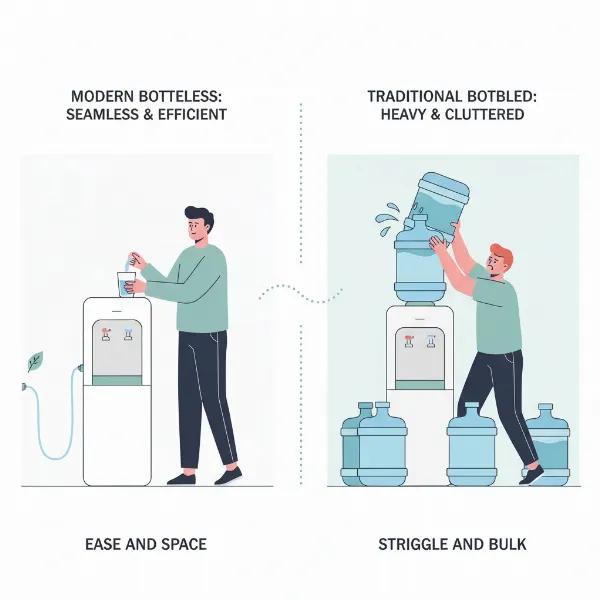 A side-by-side comparison illustrating the convenience of a bottleless water cooler versus the hassle of a bottled water cooler with heavy jugs.
Water Quality & Purity
With bottled water coolers, the water sits in plastic containers, often for extended periods in warehouses and during transport, which can raise concerns about water quality.
Bottleless systems use advanced, built-in filters (like carbon, multi-stage, or reverse osmosis) to purify tap water right at the point of use. This on-demand filtration removes contaminants such as chlorine, sediment, heavy metals, and microplastics, providing consistently clean, safer, and better-tasting water. This fresh filtration ensures a higher standard of purity and taste with every sip.
Space & Portability
Bottled water coolers require dedicated space not just for the unit but also for storing spare water bottles, which can be bulky. They offer some portability since they only need an electrical outlet.
Bottleless water coolers free up valuable floor and storage space by eliminating the need for bottles. However, their placement is limited by access to a water line.
Making the Right Choice for Your Needs
The decision between a bottleless and bottled water cooler ultimately depends on your specific priorities and usage patterns.
Choose a Bottled Water Cooler if:
- You need maximum portability and don’t have access to a direct water line.
- You have very low water consumption and the recurring costs are minimal.
- You prefer a simple, temporary hydration solution without installation.
Opt for a Bottleless Water Cooler if:
- You prioritize long-term savings and a fixed, predictable budget for water.
- You consume a significant amount of water in your home or office.
- You are environmentally conscious and want to reduce plastic waste and carbon footprint.
- You value convenience, continuous supply, and superior water quality without the hassle of bottle management.
- You are looking for a secure, hassle-free investment in hydration.
Conclusion
Choosing between bottleless and bottled water coolers involves weighing initial outlay against long-term operational costs, environmental impact, and daily convenience. While bottled systems offer immediate accessibility, their recurring expenses—from water purchases and delivery fees to the hidden costs of storage and plastic waste—quickly add up, making them a more expensive and less sustainable option over time. Bottleless water coolers, despite a higher upfront investment, consistently prove to be the more cost-effective choice in the long run, offering significant savings, superior water quality, and unparalleled convenience.
By investing in a bottleless water dispenser, you’re not just saving money; you’re also making a conscious decision to reduce your environmental footprint and ensure a consistent supply of clean, filtered water for your home or business. Are you ready to make the switch to smarter, more sustainable hydration?
Frequently Asked Questions
How much can a business save by switching to a bottleless water cooler?
Businesses can save between 50-70% annually by switching from bottled to bottleless coolers. For example, an office spending $80-$110 monthly on bottled water could reduce costs to $55-$75 with a bottleless system. These savings accumulate significantly over time, making it a financially sound decision.
Are bottleless water coolers difficult to install?
Installation for bottleless water coolers typically involves connecting the unit directly to your existing cold water line. While some basic models might allow for DIY installation, professional installation is often recommended to ensure proper plumbing and filtration setup. Many providers offer competitive installation services, with some even providing free standard installation.
What are the main ongoing costs for a bottleless water cooler?
The primary ongoing cost for a bottleless water cooler is filter replacement. These filters usually need changing every 6-12 months, with annual costs ranging from $100 to $300, depending on the type and complexity of the filtration system (e.g., carbon, multi-stage, or reverse osmosis). This is a fixed and predictable expense, unlike the variable costs of bottled water.
Is the water from a bottleless dispenser as pure as bottled water?
Yes, in many cases, water from a bottleless dispenser can be even purer than bottled water. Bottleless systems use advanced, multi-stage filtration technologies to purify tap water on demand, removing contaminants like chlorine, sediment, heavy metals, and microplastics. This ensures you’re drinking freshly filtered water, which some consider superior to bottled water that may have been stored for extended periods.
How do bottleless water coolers benefit the environment?
Bottleless water coolers offer significant environmental benefits by eliminating the need for single-use plastic bottles, drastically reducing plastic waste that ends up in landfills and oceans. They also lower carbon emissions associated with the production and transportation of bottled water, contributing to a smaller overall carbon footprint for both homes and businesses.