Staying properly hydrated is essential for health and productivity, and a water dispenser offers unparalleled convenience, providing instant access to refreshing water. However, the market offers a vast array of models, and selecting the right size water dispenser for your specific environment – be it a cozy apartment, a bustling family home, or a dynamic office – can feel overwhelming. Choosing correctly means ensuring it fits aesthetically, functions efficiently, and meets your hydration demands without occupying unnecessary space. This guide will walk you through the critical considerations to help you find the perfect fit, ensuring your water dispenser becomes a seamless and valuable addition to your daily routine.
Understanding Water Dispenser Types and Their Spatial Footprints
Before diving into measurements, it’s vital to understand the primary types of water dispensers available and how each impacts your space. Each design offers distinct advantages and different spatial requirements.
Countertop Water Dispensers are the most compact option, designed to sit conveniently on a kitchen counter, office desk, or any sturdy flat surface. They are ideal for smaller living areas, dorm rooms, or offices with limited floor space. These units typically accommodate smaller water bottles, often ranging from 2 to 5 liters, or connect directly to a water line as tankless models. Their smaller footprint makes them easy to integrate into existing layouts without major reconfigurations.
Freestanding (Floor-Standing) Water Dispensers are larger, standalone units that require dedicated floor space. These are common in larger homes, busy offices, and communal areas where higher water demand is expected. Freestanding models often work with larger 3- to 5-gallon (10- to 20-liter) bottles or are point-of-use (POU) systems connected directly to your plumbing. While they occupy more room, their robust design can handle heavy use and often come with more features like built-in storage or advanced filtration.
Under-Sink and Wall-Mounted Water Dispensers are excellent choices for maximizing space and maintaining a clean, uncluttered aesthetic. Under-sink models house the filtration system and chilling/heating components beneath your counter, delivering water through a dedicated faucet. Wall-mounted units attach directly to the wall, freeing up both counter and floor space. Both options connect directly to your water line, eliminating the need for bulky water bottles.
Portable Water Dispensers are lightweight and highly adaptable, perfect for temporary setups, outdoor events, or small, flexible workspaces. These units often operate on batteries or require only a power outlet, prioritizing mobility and ease of relocation over high capacity or advanced features.
Measure Twice, Choose Once: Assessing Your Available Space
The most fundamental step in selecting the right-sized water dispenser is accurately assessing the space where it will be placed. Ignoring this can lead to frustration, an awkward fit, or even safety hazards.
Begin by carefully measuring the height, width, and depth of your intended location. For countertop models, consider the distance from the counter to any overhead cabinets, ensuring enough clearance for the dispenser itself and for easily placing or removing water bottles. Remember to account for the space required to open top-loading bottle compartments or access controls.
For freestanding units, evaluate the available floor area. Measure not only the spot where the dispenser will sit but also consider surrounding clearance for air circulation (essential for proper cooling and heating), door swings, and ease of movement around the unit. Also, factor in accessibility for maintenance, such as cleaning the back coils or changing filters.
Furthermore, consider the location of power outlets. Bottled water dispensers require an electrical connection, and POU systems need both electricity and access to a water line. Planning for these connections in conjunction with your space measurements ensures a practical and safe installation.
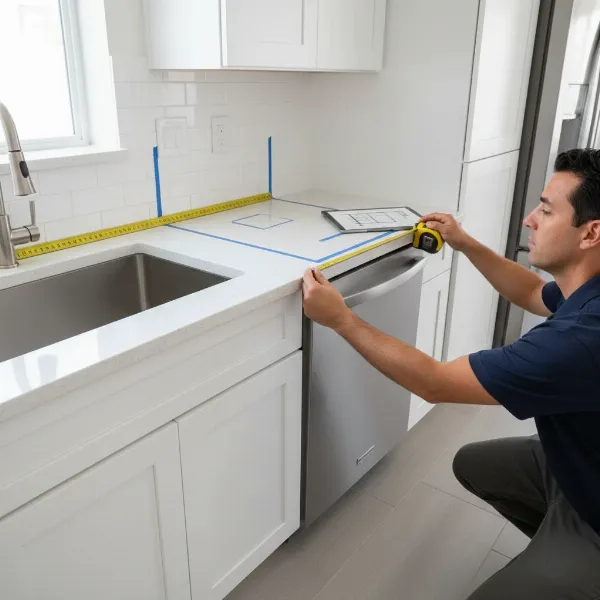 A person measuring the height and width of a kitchen countertop space where a water dispenser will be placed, with a tape measure. The kitchen is clean and modern, showing careful planning for appliance placement.
Matching Capacity to Your Hydration Demands
The physical size of your water dispenser is intrinsically linked to its water capacity and how frequently it will need refilling or maintenance. Matching the capacity to your actual consumption needs is crucial for convenience and efficiency.
For individuals or small households (1-2 people), a compact countertop dispenser holding around 2 to 3 gallons (approximately 7.5 to 11 liters) of water is typically sufficient. These smaller capacities mean more frequent refills if bottled, but they also occupy less space and are easier to manage.
Larger families (3+ people) or small offices (under 20 employees) will benefit from models with a higher capacity, generally 5 gallons (18.9 liters) or more. This reduces the frequency of bottle changes, which can be particularly advantageous in busy environments. For offices, a good rule of thumb is to aim for at least one water dispenser per 25 employees to accommodate varied usage patterns throughout the day.
For large offices or commercial spaces with 50 or more employees, multiple high-capacity dispensers or plumbed-in (POU) systems are often necessary to meet the continuous demand and prevent queues. The capacity of a dispenser directly influences how often it needs attention, so understanding your consumption habits, especially during peak hours, is key to avoiding an appliance that constantly runs dry or requires burdensome refills. Recent trends even show a growing popularity for 20-liter and 40-liter dispensers in professional settings, highlighting the demand for greater bulk water solutions.
Comparing Common Water Dispenser Sizes: A Quick Guide
To help you visualize and differentiate, here’s a comparison of the most common water dispenser types based on their typical size and ideal applications.
| Feature | Countertop Water Dispenser | Freestanding Water Dispenser |
|---|---|---|
| Size | Compact, portable | Larger, floor-standing |
| Footprint | Small (sits on existing surface) | Significant (requires dedicated floor space) |
| Capacity | Lower (e.g., 2-5 liter bottles, or tankless) | Higher (e.g., 3-5 gallon bottles, or POU) |
| Mobility | Easy to move | Limited mobility once placed |
| Ideal For | Small kitchens, dorms, small offices, personal use | Larger homes, offices, communal areas, high-traffic zones |
| Installation | Plug and play (bottled), or simple plumbing (POU) | Plug and play (bottled), or plumbing (POU) |
Beyond Dimensions: Other Key Factors to Consider
While size is paramount, several other factors contribute to choosing the right water dispenser that seamlessly integrates into your space and lifestyle.
Water Source: Decide between bottled water dispensers or point-of-use (POU) systems. Bottled dispensers require storage space for spare bottles and a plan for regular deliveries. POU systems, which connect directly to your water line, eliminate bottle storage but require proximity to plumbing and potentially professional installation. This choice significantly impacts the overall “size” of your hydration solution, not just the unit itself.
Features and Functionality: Consider whether you need hot, cold, or room-temperature water. Many larger, freestanding units offer multiple temperature options, sometimes even including sparkling water, built-in mini-fridges, or advanced filtration systems. These additional features can affect the internal components and overall dimensions of the dispenser. Child safety locks for hot water are also a practical consideration for families.
Aesthetics and Design: Your water dispenser should complement its surroundings. Modern designs, sleek finishes, and color options can help the unit blend in or stand out as a stylish appliance. While not directly a size factor, how the dispenser looks in its allocated space contributes to overall satisfaction.
Budget: Generally, smaller, more basic countertop models are more budget-friendly in terms of initial cost. Larger freestanding units or POU systems with advanced features and filtration often come with a higher upfront investment, though POU models can offer long-term savings by eliminating recurring bottle costs.
“The perfect water dispenser isn’t just about how much water it holds; it’s about how elegantly it fits into your daily life and space, enhancing rather than hindering your environment.” – Admin, WaterDispenserPro.com
Optimal Placement and Maintenance for Longevity
Once you’ve chosen the perfect size and type of water dispenser, thoughtful placement and routine maintenance will ensure its longevity and optimal performance.
Ensure your dispenser is placed on a stable, level surface capable of supporting its weight, especially when a full water bottle is loaded. For proper cooling and heating, allow adequate clearance around the back and sides of the unit for ventilation. This prevents overheating and helps the dispenser operate more efficiently.
Accessibility is key for maintenance tasks. Make sure there’s enough room to easily change water bottles, access filters for replacement, and perform routine cleaning of the reservoir and dispensing area. A poorly placed dispenser might lead to neglected maintenance, affecting water quality and the appliance’s lifespan. Positioning it near a power outlet and, for POU models, a water line, simplifies installation and use.
By carefully considering your space, consumption needs, and the various types and features available, you can confidently select a water dispenser that is perfectly sized and suited to your home or office.
Frequently Asked Questions
What is the average size difference between countertop and freestanding water dispensers?
|
Our Picks for the Best Water Dispenser in 2026
As an Amazon Associate I earn from qualifying purchases.
|
||
| Num | Product | Action |
|---|---|---|
| 1 | Brita UltraMax Large Water Dispenser With Standard Filter, BPA-Free, Reduces Copper, Cadmium and Mercury Impurities, Lasts 2 Months or 40 Gallons, Includes 1 Filter, Kitchen Accessories, Large 27-Cup |

|
| 2 | New Wave Enviro Porcelain Water Dispenser, Classic Blue Stripe |
|
| 3 | Brio Self Cleaning Bottom Loading Water Cooler Water Dispenser – Limited Edition - 3 Temperature Settings - Hot, Cold & Cool Water |
|
| 4 | Brio 130 Series Top-Load Water Cooler Dispenser for 3- and 5-Gallon Bottles, Hot & Cold, Spill-Free Loading, Child Safety Lock, Energy Star 3.0, Black |
|
| 5 | Water Dispenser 5 Gallon Water Bottle Pump |
|
| 6 | Brio 520 UV Self-Cleaning Bottleless Water Cooler Dispenser, UL Certified - Built-in 2 Stage Filtration (2 Free Replacement Filters Included) Reduces PFAS & Microplastics - 3 Temp (Hot Cold, Room) |
|
| 7 | Water Jug Pump for 5 Gallon Bottle – Portable Electric USB-C Charging Dispenser, Dual Powerful Motors, Fast Flow, Fits 2-5 Gallon Jugs – Ideal for Home, Office, Camping, RV, Black |
|
| 8 | Brio Self Cleaning Bottom Loading Water Cooler Water Dispenser – Black Stainless Steel - 3 Temperature Settings - Hot, Room & Cold Water |
|
| 9 | Igloo Top Loading Water Cooler – Hot & Cold Dispenser – Black & Stainless Steel, Holds 3 & 5 Gallon Jugs, Child Safety Lock – for Homes, Kitchens, Offices, Dorms |
|
| 10 | Brio Limited Edition Top Loading Water Cooler Dispenser - Hot & Cold Water, Child Safety Lock, Holds 3 or 5 Gallon Bottles - UL/Energy Star Approved |
|
Countertop water dispensers are typically compact, designed to fit under standard cabinets, often around 15-20 inches tall. Freestanding models are much larger, standing on the floor at heights ranging from 35-50 inches, similar to a small refrigerator, requiring significantly more vertical space.
How much water capacity do I need for a family of four?
For a family of four, a water dispenser with a capacity of at least 5 gallons (18.9 liters) is generally recommended. This size balances the need for ample water supply with reasonable refill frequency, ensuring everyone has access to fresh water throughout the day without constant bottle changes.
Can I place a water dispenser in a small bedroom?
Yes, you can place a water dispenser in a small bedroom, but a compact countertop or a portable model would be the most suitable choice. Ensure there is adequate space on a sturdy surface, proper ventilation around the unit, and a conveniently located power outlet to prevent clutter and ensure safe operation.